Spec-Driven Development (SDD) Standard
Turn a PRD into a reviewable, executable spec first, then let the Agent plan, break down, and execute: PRD → spec.md → plan.md → task.md → code.
Spec-Driven Development (SDD) Standard
Spec-Driven Development · PRD → spec.md → plan.md → task.md → code
In the AI era, the tech lead first turns a PRD into a clear spec, and the Agent then plans, breaks down, and executes code based on that spec.
Version: v1.0 | Date: 2026-06-01 | Status: Draft / Reviewable
1. Core Definition
In this document, SDD means Spec-Driven Development, not the traditional Software Design Document. It emphasizes: convert requirements into a reviewable, executable spec first, then let the Agent generate the plan, tasks, and code according to that spec.
The core of SDD is not "let the AI write code directly" — it's establishing a stable delivery chain:
- The product manager or business side provides the PRD / requirement input.
- The tech lead converts the PRD into
spec.md, making clear what to do, why, the acceptance criteria, and the boundaries. - The Agent generates
plan.mdfromspec.md, filling in architecture, data, interfaces, exceptions, and risk plans. - The Agent breaks
plan.mdintotask.md, turning the plan into step-by-step executable tasks. - The Agent executes automatically per
task.md, while developers review, build, and release at key checkpoints.
1.1 Role Boundaries
| Role | Main Responsibilities | What They Should Not Do |
|---|---|---|
| Product manager / business side | Provide the PRD, business goals, user scenarios, acceptance criteria. | Not decide technical implementation details directly. |
| Tech lead / developer | Turn the PRD into a spec; review spec.md, plan.md, task.md, and code; own final quality. | Not hand vague requirements straight to the Agent to write code. |
| Agent | Research and understand context, draft specs, technical planning, task decomposition, execute code and tests. | Not expand scope on its own for tasks that haven't passed review. |
| CI / build system | Run tests, build artifacts, verify quality gates. | Not replace human judgment on requirements and architecture. |
2. The "Truth" Inversion in the AI Era
The core idea: the tech lead writes the spec from the PRD, and the Agent generates code from the spec.
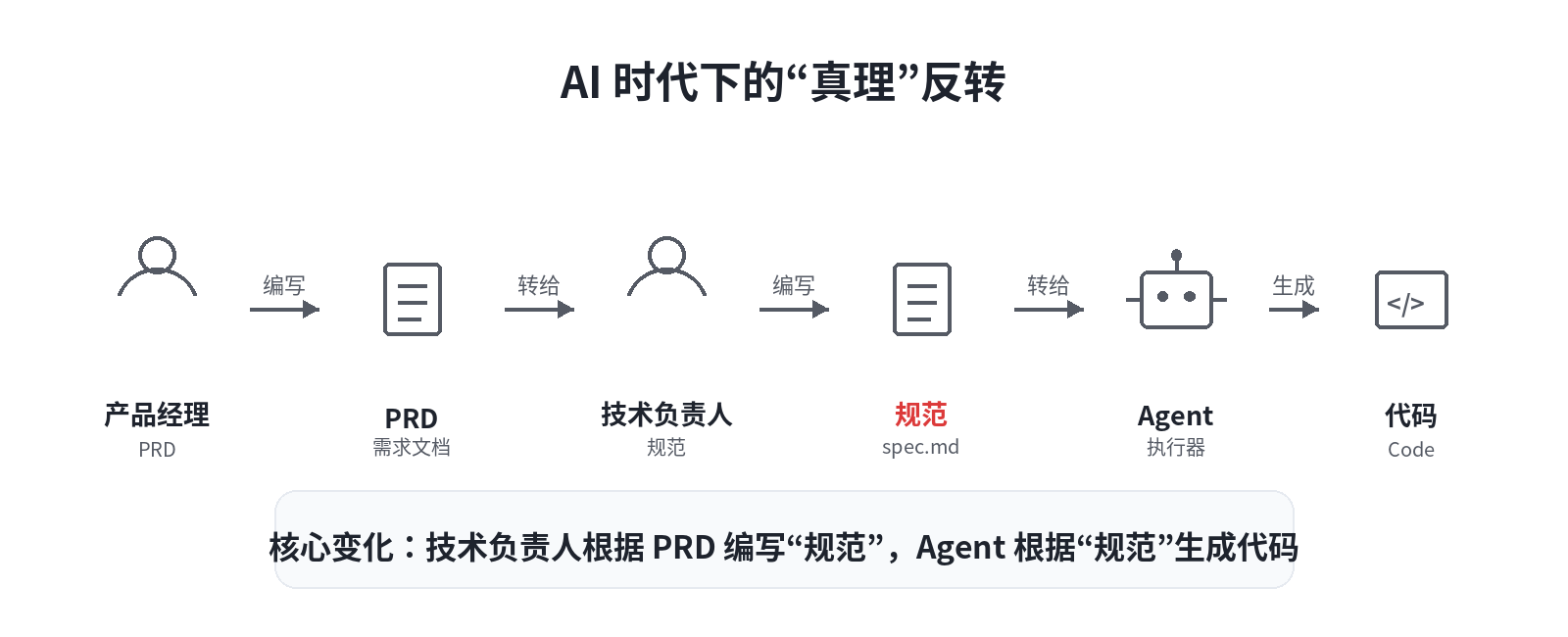
2.1 Key Principles
- The spec matters more than a one-off prompt. A prompt can trigger an action; the spec constrains the result.
- Code is not the first artifact —
spec.md/plan.md/task.mdare the reviewable, reusable, traceable deliverables. - People own intent, boundaries, judgment, and acceptance; the Agent owns information gathering, plan generation, task decomposition, and repeated execution.
- Every stage must have a review point. When a review fails, go back to the previous stage and fix the spec, rather than hacking the code.
3. SDD Workflow
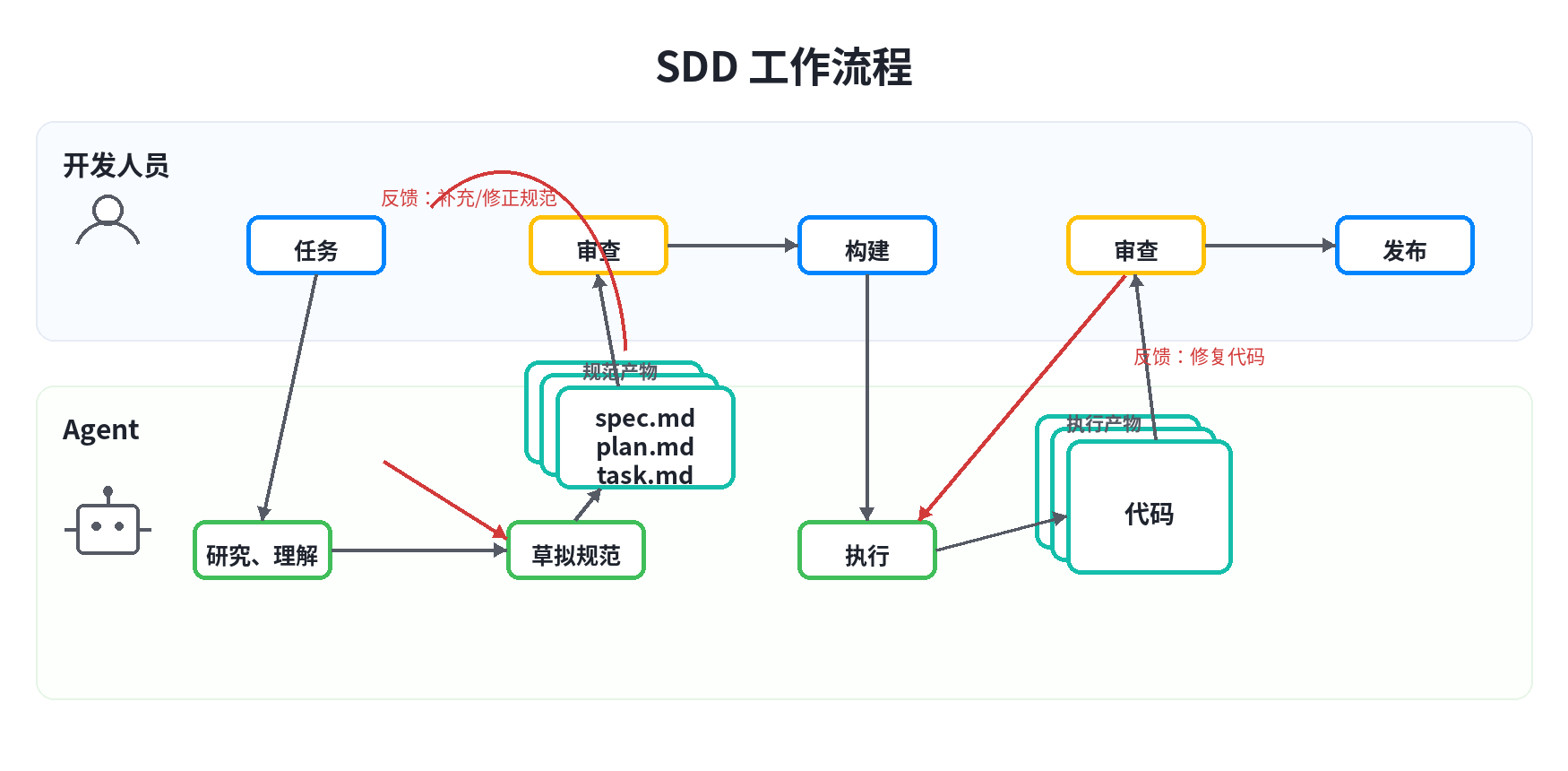
3.1 Standard Flow
| Step | Action | Owner | Output / Gate |
|---|---|---|---|
| 1 | Initiate the task, clarifying the requirement source, repo, branch, and goal. | Developer | Clear task entry. |
| 2 | Research and understand the PRD, code context, historical design, and constraints. | Agent | Question list / context summary. |
| 3 | Draft the spec, producing spec.md, plan.md, task.md. | Agent | Reviewable spec artifacts. |
| 4 | Review the spec artifacts, confirming scope, technical plan, task order. | Developer | Proceed to execution after review passes. |
| 5 | Execute development per task.md, completing code, tests, and docs item by item. | Agent | Code artifacts, test results. |
| 6 | Review code and build. If issues are found, return to execution or planning. | Developer / CI | Build passes, quality gates pass. |
| 7 | Release and record the version, changes, and rollback strategy. | Developer | Shippable artifact. |
3.2 Loop Rules
- Requirement unclear: return to intent definition, extend
spec.md. - Plan unstable: return to technical planning, extend
plan.md. - Task not executable: return to task decomposition, refine
task.md. - Code doesn't meet expectations: return to automated execution, fix per task; if a design error is found, update
plan.mdin sync. - Anywhere implementation and docs diverge, the corresponding doc must be updated before merging.
4. The Four SDD Stages
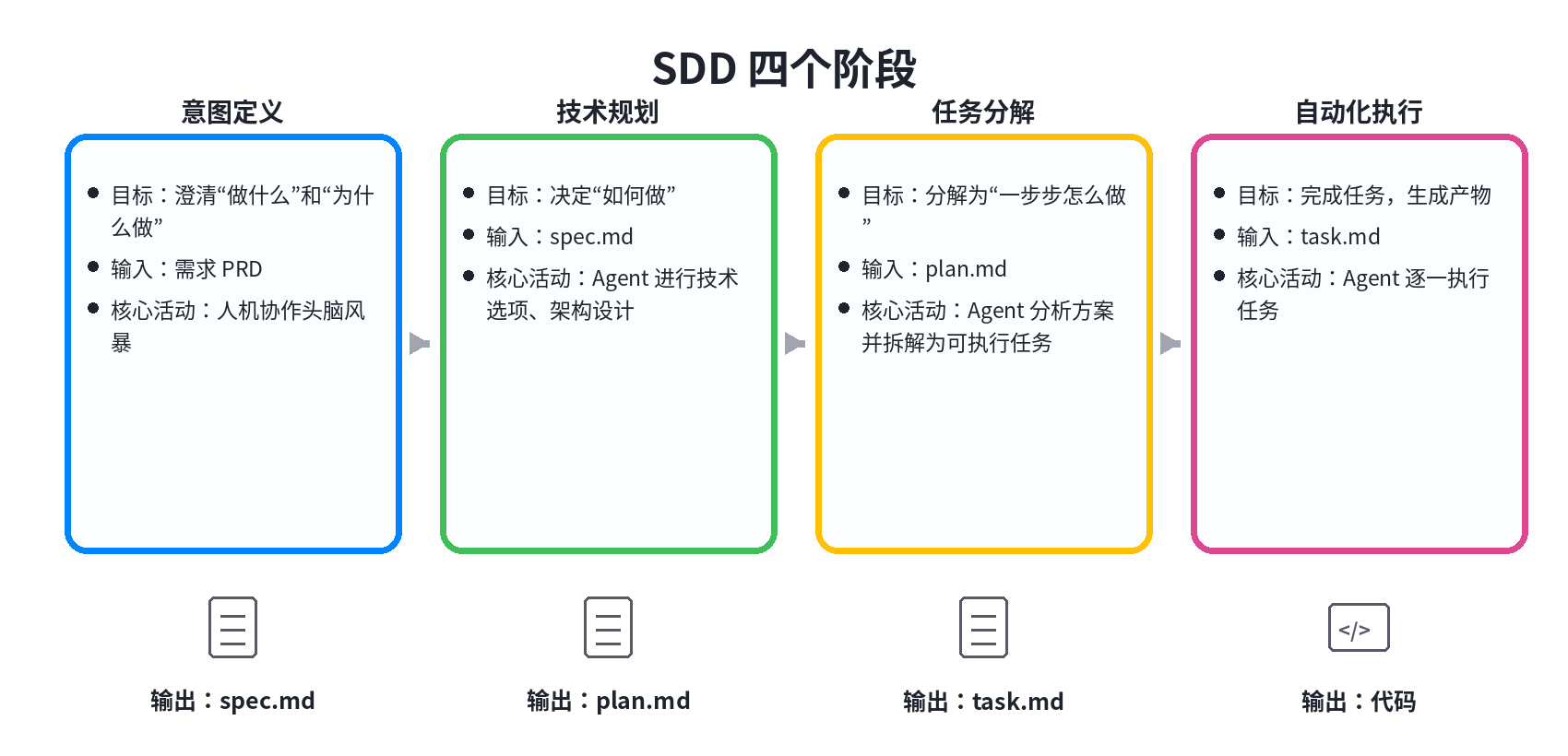
4.1 Stage Descriptions
| Stage | Goal | Input | Core Activities | Output |
|---|---|---|---|---|
| Intent definition | Clarify "what to do" and "why". | Requirement PRD | Human–AI brainstorming to fill in background, boundaries, acceptance, and risks. | spec.md |
| Technical planning | Decide "how to do it". | spec.md | The Agent analyzes technical options and designs architecture, interfaces, and data. | plan.md |
| Task decomposition | Break down into "step-by-step how". | plan.md | The Agent analyzes the plan and splits it into executable tasks. | task.md |
| Automated execution | Complete tasks and produce artifacts. | task.md | The Agent executes tasks one by one, runs tests, and outputs code. | Code |
4.2 Definition of Done per Stage
| Stage | Definition of Done |
|---|---|
| Intent definition | Goals, non-goals, user scenarios, acceptance criteria, constraints, and risks are all written clearly; no unverifiable phrasing like "maybe / roughly / it depends". |
| Technical planning | Module boundaries, interfaces, data, exceptions, permissions, security, performance, migration, and rollback all have clear plans. |
| Task decomposition | Each task can be executed and accepted independently; task order is clear; tests and rollback notes are included. |
| Automated execution | Code, tests, build, and docs are completed in sync; the PR maps directly to spec.md / plan.md / task.md. |
5. Artifact Standards
Recommended unified directory:
docs/sdd/<feature-name>/spec.md
docs/sdd/<feature-name>/plan.md
docs/sdd/<feature-name>/task.md
docs/sdd/<feature-name>/review.md
5.1 spec.md: Intent Definition Doc
Purpose: answer "what to do, why, and to what extent". spec.md is the single requirement basis for the later plan.md and task.md.
- Must include: background, goals, non-goals, user scenarios, feature scope, acceptance criteria, constraints, risks, and open questions.
- Must not include: unconfirmed implementation details, subjective descriptions without acceptance criteria, ad-hoc verbal agreements.
- Quality bar: someone who didn't join the discussion can, after reading
spec.md, judge whether the feature is built correctly.
5.2 plan.md: Technical Planning Doc
Purpose: answer "how to do it, why this way, and what to do on failure". plan.md is the design basis for task decomposition and code execution.
- Must include: overall architecture, module boundaries, data design, interface design, state transitions, exception/degradation, security/permissions, performance/capacity, deployment config, compatibility/migration, and rollback plan.
- Must state the reason for each technical choice — no empty phrases like "adopt an advanced architecture".
- Quality bar: another developer can independently break down tasks after reading
plan.md.
5.3 task.md: Task Decomposition Doc
Purpose: answer "step-by-step how". task.md must be small enough, clear enough, executable, and verifiable.
- Each task achieves exactly one clear goal.
- Each task must state its input, files to modify, execution steps, acceptance criteria, and test command.
- Tasks must be ordered, and prerequisites must be written clearly.
- If the plan turns out unreasonable during execution, pause and write back to
plan.mdrather than forcing code through.
5.4 Code Artifacts: Execution Results
- Code commits must be traceable to a task number in
task.md. - Every PR must link spec.md, plan.md, task.md.
- When implementation and docs diverge, update the docs first, then merge the code.
- Must include the necessary tests, build results, and rollback notes.
6. Review Gates
| Gate | Review Target | Pass Criteria | On Failure |
|---|---|---|---|
| Gate 1 | spec.md | Requirement boundaries clear, acceptance criteria testable, risks recorded. | Return to intent definition; complete requirements and boundaries. |
| Gate 2 | plan.md | Architecture, interfaces, data, exceptions, permissions, performance, and rollback plans are clear. | Return to technical planning; re-evaluate the plan. |
| Gate 3 | task.md | Tasks are executable, acceptable, correctly ordered, and appropriately granular. | Return to task decomposition; split smaller or reorder. |
| Gate 4 | Code / build | Code meets task requirements, tests pass, build passes, docs in sync. | Return to execution; if design is wrong, return to plan.md. |
6.1 Hard Rules
- No
spec.md, no technical planning. - No
plan.md, no splittingtask.md. - No
task.md, no automated code execution by the Agent. - Docs that haven't passed review cannot be input to a downstream stage.
- Before going live, you must be able to trace code → task, task → plan, plan → requirement.
7. Agent Collaboration Standard
7.1 Input Package Requirements
- Requirement input: PRD, issue, user story, screenshots, or acceptance criteria.
- Code context: repo path, tech stack, key directories, existing interfaces, existing data structures.
- Constraints: what must not change, compatibility requirements, performance requirements, security requirements, launch deadline.
- Output requirement: this round outputs only one of spec.md / plan.md / task.md / code — no mixing across stages.
7.2 Staged Prompt Templates
# Stage 1: Generate spec.md
Generate spec.md based on the following PRD.
Requirement: clarify only "what to do" and "why"; do not write concrete code.
Must include: background, goals, non-goals, user scenarios, acceptance criteria, constraints, risks, open questions.
# Stage 2: Generate plan.md
Generate plan.md based on the confirmed spec.md.
Requirement: explain how to implement it and justify the technical choices.
Must include: architecture, modules, data, interfaces, state, exceptions, permissions, security, performance, deployment, rollback, test plan.# Stage 3: Generate task.md
Break down task.md based on the confirmed plan.md.
Requirement: every task must be small, executable, and acceptable.
Each task includes: id, goal, input, files to modify, execution steps, acceptance criteria, test command, rollback notes.# Stage 4: Automated execution
Execute top-to-bottom per task.md.
Rules: run one task at a time; run the corresponding tests after each; if plan.md is unreasonable, pause and state which design points need updating.7.3 Agent Output Constraints
- On unclear requirements, ask first — never guess.
- When generating
plan.md, list alternatives and the rationale for the trade-off. - When generating
task.md, avoid "mega-tasks" — e.g. "complete the entire backend" is not acceptable. - When executing code, update task status and keep test results.
- Any automatic change must stay within the current task's scope; no incidental refactoring of unrelated modules.
8. Team Adoption Standard
8.1 Repository Layout
docs/
  sdd/
    <feature-name>/
      spec.md       # intent definition
      plan.md       # technical planning
      task.md       # task decomposition
      review.md     # review record, optional
src/
  ...
tests/
  ...
8.2 Naming Conventions
| Object | Naming Rule | Example |
|---|---|---|
| Feature directory | YYYYMMDD-feature-name | 20260601-conversation-history |
| Doc files | Fixed file names | spec.md / plan.md / task.md |
| Task id | T + two digits | T01 initialize data structures |
| Commit message | <task-id>: <summary> | T03: add cursor pagination |
| PR title | [SDD][feature] summary | [SDD][history] add conversation filter |
8.3 State Transitions
| State | Meaning | Entry Condition | Next Step |
|---|---|---|---|
| Draft | Document draft. | Agent or developer completes the first draft. | Submit for review. |
| Reviewing | Under review. | Review initiated. | Revise or pass. |
| Approved | Review passed. | Key stakeholders confirm. | Proceed to the next stage. |
| Implementing | In execution. | task.md passed review. | Code execution and testing. |
| Released | Released. | Build, test, and release completed. | Retrospective and knowledge capture. |
8.4 PR Rules
- The PR description must include the paths of the linked spec.md, plan.md, task.md.
- The PR description must list the completed task numbers.
- The PR must include the test commands and results.
- Changes involving databases, permissions, billing, payments, updates, or state machines must add a rollback plan.
9. SDD Review Checklist
| Category | Check | Pass Criteria |
|---|---|---|
| Requirements | Are goals and non-goals clear? | You can clearly tell what is in scope and what isn't. |
| Requirements | Are acceptance criteria testable? | Each criterion can become a test case. |
| Architecture | Are module boundaries clear? | You know what each module is and isn't responsible for. |
| Data | Any schema, index, or migration involved? | Concrete DDL / migration / rollback notes exist. |
| Interfaces | Are requests, responses, and error codes complete? | Frontend and backend can develop and integrate independently. |
| State | Any task or state transitions? | States, triggers, terminal states, and error states are clear. |
| Security | Are permissions and privilege-escalation risks described? | Identity source, access boundaries, and audit records are clear. |
| Exceptions | Are failures, timeouts, retries, and degradation described? | Every major failure has a handling strategy. |
| Testing | Are unit, integration, regression, and build covered? | Runnable commands exist once a task is done. |
| Launch | Are canary, monitoring, and rollback clear? | You know how to roll back when something goes wrong. |
9.1 One-Sentence Pass Bar
A developer who didn't join the early discussion can, after reading
spec.md,plan.md, andtask.md, know why it's being done, how, in what order, how to test, how to launch, and how to roll back on failure.
Appendix A: Templates
A.1 spec.md Template
# <feature-name> spec.md
Status: Draft / Reviewing / Approved
Author:
Linked PRD / Issue:
Created:
Last updated:

## 1. Background
- Current problem:
- Business impact:
- Why now:

## 2. Goals
- Goal 1:
- Goal 2:

## 3. Non-Goals
- Out of scope this cycle:

## 4. User Scenarios
- Scenario 1: As a <user>, I want <capability> so that <value>.

## 5. Feature Scope
- Features:
- Boundaries:

## 6. Acceptance Criteria
- AC1:
- AC2:

## 7. Constraints & Risks
- Constraints:
- Risks:

## 8. Open Questions
- Q1:
A.2 plan.md Template
# <feature-name> plan.md
Status: Draft / Reviewing / Approved
Input: spec.md

## 1. Overall Plan
- Summary:
- Tech choices:
- Trade-off rationale:

## 2. Architecture & Modules
- Module A: responsibilities / not responsible for
- Module B: responsibilities / not responsible for

## 3. Data Design
- Schema:
- Indexes:
- Migration:
- Rollback:

## 4. Interface Design
- API:
- Request params:
- Response structure:
- Error codes:

## 5. State Transitions
- State definitions:
- State machine:

## 6. Exceptions & Degradation
- Timeout:
- Retry:
- Degradation:

## 7. Security & Permissions
- Identity source:
- Permission rules:
- Privilege-escalation risks:

## 8. Test Plan
- Unit tests:
- Integration tests:
- Regression tests:

## 9. Launch & Rollback
- Launch steps:
- Monitoring metrics:
- Rollback plan:
A.3 task.md Template
# <feature-name> task.md
Status: Draft / Reviewing / Approved / Implementing / Done
Input: plan.md

## Execution Rules
- Run one task at a time.
- Run the corresponding tests after each task.
- If the design is unreasonable, pause and write back to plan.md.

## Task List

### T01 <task-name>
- Goal:
- Prerequisites:
- Input:
- Files to modify:
- Execution steps:
  1.
  2.
- Acceptance criteria:
- Test command:
- Rollback notes:
- Status: Todo / Doing / Done

### T02 <task-name>
- Goal:
- Prerequisites:
- Input:
- Files to modify:
- Execution steps:
- Acceptance criteria:
- Test command:
- Rollback notes:
- Status: Todo
Last updated on
Team Collaboration SOP and Technical Practices
Heicode team collaboration norms, AI Code usage, the AIE review mechanism, and practical recommendations for large teams and complex projects.
Heicode Manager Enterprise Guide
A complete management guide for enterprise organizations — from rule configuration and resource binding to project approval and cost observability.