Heicode Agent Swarm
Heicode Agent Swarm: What Makes It Different
In one sentence
Heicode's Agent Swarm is an AI collaboration mechanism built for real software delivery. It isn't simply launching multiple AIs at once — it's having multiple Agents work around a single user goal, together, within a unified system of tasks, resources, artifacts, and audit records.
Swarm mode uses a lead-plus-worker architecture: each tenant maps to an Azure virtual machine, on which an api container, a lead container, and several worker containers run via docker-compose. The lead receives the user's goal, breaks the task down, and dispatches it to workers; workers claim tasks, execute them, report heartbeat, and send results back to the lead for aggregation. Up to 8 workers, 3 by default (adjustable by plan).
User states a goal
-> Heicode understands the requirements
-> The lead Agent breaks down the task
-> The lead dispatches subtasks to worker Agents
-> Workers execute, report heartbeat, and return results
-> High-risk operations go through approval
-> The lead aggregates the results
-> Artifacts, logs, usage, and audit are reported back together
Heicode automatically organizes an AI development team around your goal, letting different Agents handle requirements, architecture, code, testing, review, deployment, and maintenance respectively — and safely records the process along the way.
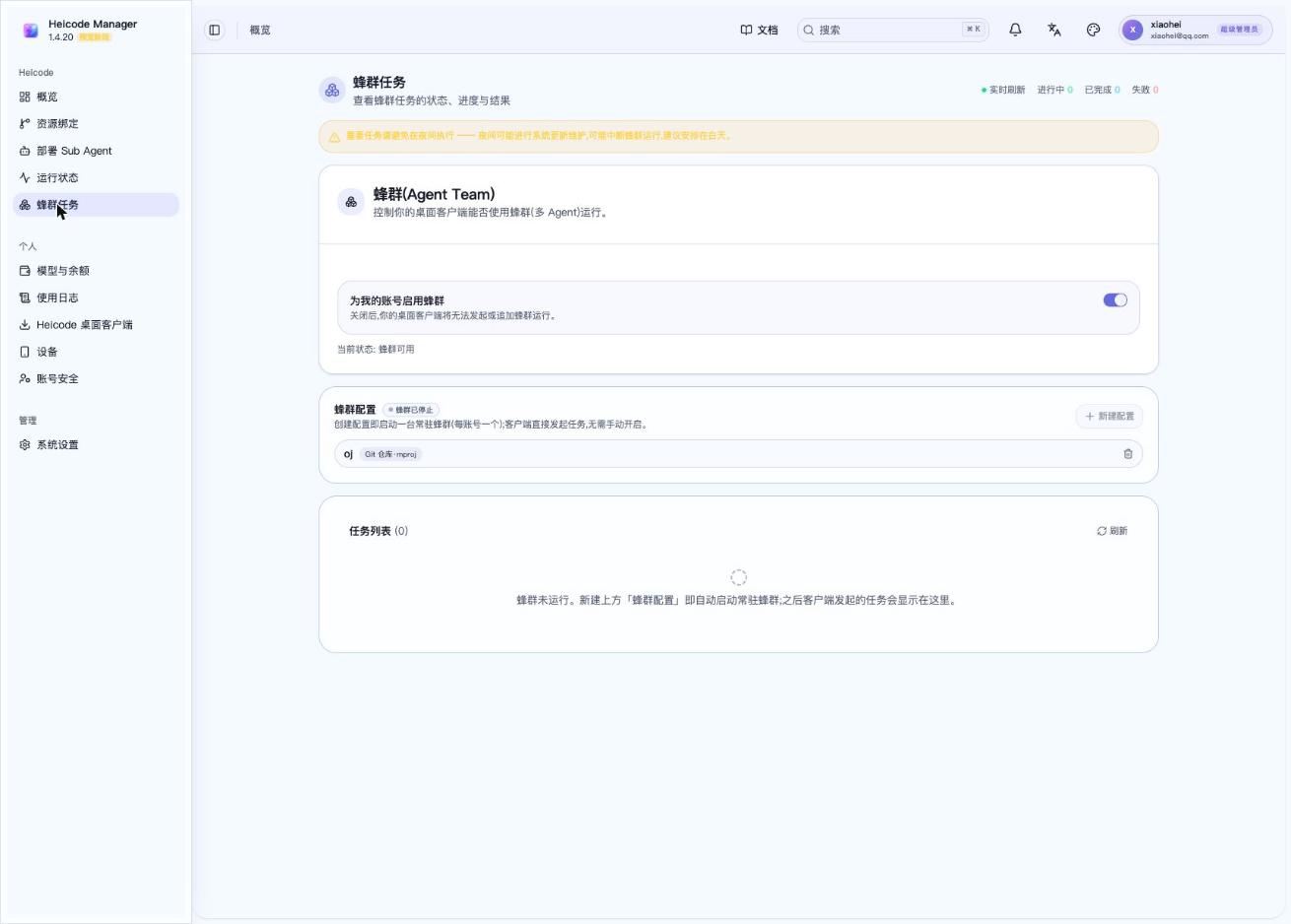
Why we need an Agent Swarm
A single AI assistant is well-suited to answering questions or completing a local task, but real software development is rarely a single-point action.
Taking a product from idea to launch usually involves:
- Understanding requirements.
- Breaking down the product.
- Technical design.
- Frontend development.
- Backend development.
- Database design.
- Test verification.
- Security review.
- Deployment and launch.
- Log troubleshooting.
- Ongoing maintenance.
Relying on a single Agent tends to run into a few problems:
- It easily loses track of key points once context gets too long.
- Complex task decomposition is unstable.
- There's no proper handoff between coding, testing, and deployment.
- After a failure, it doesn't know how to feed that back into a fix.
- Resource permissions, secrets, and production operations are hard to control.
- Customers can't clearly see who did what, what resources were used, or what the result was.
The value of an Agent Swarm is handing a big goal to the lead Agent, which breaks it into multiple trackable, collaborative, verifiable subtasks, then has multiple worker Agents complete them in parallel within controlled boundaries.
The Swarm technology inside Heicode's product
Heicode's Swarm technology is made up of the following parts:
Goal understanding -> lead task decomposition -> parallel worker execution -> result aggregation -> governance and auditTogether, these capabilities form Heicode's AI development team operating mechanism.
1. lead Agent: breaking down and dispatching tasks
Each time a customer launches a goal, the lead Agent receives the goal, understands the requirements, breaks it into subtasks, and dispatches them to worker Agents for execution.
For example, a customer might enter:
Add a team member invitation feature to the existing codebase, and complete testing.The lead breaks down tasks around this goal and dispatches them to workers; all subsequent tasks, artifacts, usage, and audit records for this run belong to it.
Customer value:
- Each task has its own independent record.
- The process can be viewed.
- Results can be reviewed and accepted.
- Failures can be traced.
- Usage can be attributed.
2. Parallel worker execution: actually getting the work done
Worker Agents start executing the subtasks dispatched by the lead. When new problems come up during execution, the lead can dispatch new tasks, for example:
- If a test fails, a fix task is automatically generated and dispatched to a worker.
- If insufficient permissions are found, it moves to resource supplementation or approval.
- If deployment risk is found, a rollback plan is generated.
- If requirements are incomplete, it goes back to the customer for confirmation.
Customer value:
- The system isn't mechanically executing a fixed process.
- Tasks can adjust themselves based on actual conditions.
- Progress can continue after a failure.
- Customers can see why a task was added, why it was paused, and why approval is needed.
3. Capability formation: organizing workers around what the task needs
Heicode doesn't require customers to manually choose the number of workers — the lead decides how many subtasks to break the goal into and how many workers to dispatch them to (not exceeding the plan's cap, up to 8, 3 by default).
A simple task might only need a small number of workers to handle understanding the goal, implementation, and verification; a complex task will use more workers, handling product understanding, architecture analysis, frontend implementation, backend implementation, security review, test verification, ops deployment, documentation, and more, respectively.
Customer value:
- No need to understand the underlying Agent configuration.
- The more complex the task, the more workers the system organizes automatically.
- Every Agent has clearly defined responsibilities and boundaries.
- Customers can see "who is doing what."
4. The shared resource layer: Swarm's shared workbench
The shared resource layer is the core of Heicode's Swarm technology. It lets the lead and multiple workers use the same set of tasks, resources, artifacts, and audit records. Without a shared resource layer, multiple Agents would just be running at the same time; with it, the lead and workers can actually collaborate.
The shared resource layer includes:
| Layer | Role |
|---|---|
| Task layer | Manages tasks broken down by the lead, worker claim/execution status, and failure retries |
| Artifact layer | Stores code diffs, test reports, documentation, deployment plans, and log summaries |
| Permission layer | Manages Git, documentation, SK, cloud resources, and secret references |
| Approval layer | Manages high-risk confirmations for production deployment, cloud operations, secret access, etc. |
| Audit layer | Records the subject, resource, time, result, and usage of every action |
Customer value:
- Multiple Agents don't operate in isolation from each other.
- Tasks can be handed off.
- Failures can flow back for fixing.
- Artifacts can be viewed centrally.
- Permissions and secrets don't get out of control.
- The process can be audited.
5. Controlled autonomy: allowing automatic collaboration, but never exceeding authority
Heicode's Swarm doesn't leave AI to operate completely freely. It uses controlled autonomy:
Agents can automatically break down tasks, claim tasks, call tools, produce artifacts, and fix failures.
But Agents cannot cross the boundaries of permissions, secrets, budget, approval, and audit.
What's controlled includes:
- User identity.
- Resource access scope.
- Git path scope.
- SK skill invocation scope.
- Cloud resource operation scope.
- Model budget.
- Production deployment.
- Data deletion.
- Production secret access.
- Audit records.
Customer value:
- Automation brings efficiency.
- Approval and permissions guarantee safety.
- Every key action is traceable.
- Enterprise customers can safely connect their own code and cloud resources.
6. Minimal context: giving every Agent just enough information
Heicode doesn't dump the entire conversation history, all the code, and all resources onto every Agent at once. The system prepares the minimum usable context for each task, including:
- The current task goal.
- A summary of relevant requirements.
- The scope of editable files.
- References to usable resources.
- Which SKs can be called.
- Prohibited actions.
- Acceptance criteria.
- Failure history.
- Approval requirements.
Customer value:
- Agents don't get unnecessary information.
- The context is more accurate.
- The scope of code changes is more controllable.
- Secrets and sensitive resources don't enter ordinary context.
7. Deliverables: making results viewable and acceptable
Heicode's Swarm emphasizes artifacts, not just conversation. Every key task should leave behind viewable deliverables, commonly including:
- Requirements summary.
- Technical approach.
- Code diff.
- Test report.
- Failure reason.
- Fix record.
- Deployment plan.
- Rollback plan.
- Usage instructions.
- Delivery summary.
Customer value:
- You're not just looking at what the AI said.
- You can see the actual output.
- You can review every step.
- You can judge whether acceptance criteria are met.
Heicode Swarm's product characteristics
1. A continuous experience from idea to delivery
Customers don't need to manually coordinate requirements, code, deployment, security, and audit across multiple systems. Heicode organizes these stages into one continuous flow:
Idea -> Requirements -> Task -> Development -> Testing -> Review -> Deployment -> Audit -> MaintenanceThis lets customers see the full software lifecycle, rather than a single AI conversation.
2. Customers only confirm key decisions, not low-level parameters
Customers don't need to understand:
- Kubernetes.
- The details of Azure VM and docker-compose orchestration.
- OpenBao paths.
- The specific format of secret_ref.
- The Agent's internal scheduling strategy.
Customers only need to confirm:
- What to do.
- Which resources are allowed to be used.
- Which actions require approval.
- Whether to accept the current execution result.
3. Can connect to a customer's existing code and cloud resources
Heicode's Swarm doesn't only generate code in a blank environment — it can work around a customer's existing resources:
- Git repositories.
- Project documentation.
- SK skills.
- Cloud accounts.
- Cloud resources.
- Test environments.
- Deployment environments.
Customer value:
- You can continue developing on top of an existing project.
- You can bring AI into a real engineering workflow.
- No need to rebuild a separate development environment.
4. Uses secrets and cloud resources safely
Once a customer authorizes a resource, Heicode never exposes long-lived secrets to Agents. The system controls resource access through:
- The secret vault.
- secret_ref.
- Short-lived credentials.
- Permission scopes.
- Client-side approval.
- Audit records.
Customer value:
- No need to copy secrets over to the AI.
- No need to worry about an Agent holding production secrets long-term.
- High-risk operations can be approved, rejected, and traced.
5. Failures are explainable, and the process is reviewable
With traditional AI tools, customers often only see an error result after a failure. Heicode's Swarm records:
- Which task failed.
- Which worker's execution failed.
- At which step the failure happened.
- Whether it has already been retried.
- Whether a fix task was generated.
- Whether customer approval or additional resources are needed.
Customer value:
- Failure isn't a black box.
- The team can conduct a retrospective.
- The system can keep fixing things.
6. Usage and cost are visible
Running an Agent Swarm generates model calls and runtime resource consumption. Heicode ties usage to tasks:
- Which task consumed model usage.
- Which worker generated the calls.
- Whether the current budget is close to its cap.
- Whether large-consumption approval has occurred.
Customer value:
- Cost is explainable.
- Budget is controllable.
- Team usage is more transparent.
7. Scales gradually for individuals, teams, and enterprises
Individual users can use Swarm to quickly deliver from idea to MVP. Team users can use Swarm to collaborate on requirements, development, testing, and deployment. Enterprise users can run Swarm within their existing code, cloud resources, permissions, and audit systems. Customers of different sizes see the same set of product capabilities, but the worker count cap, approvals, budget, and security boundaries can be adjusted by plan.
Heicode Swarm's core distinguishing features
1. Goal-driven — customers don't need to choose a complex flow
Customers don't need to plan out a task graph or role division in advance. They just need to describe the goal, for example:
I want to build a small-team task management SaaS,
with login, projects, tasks, comments, notifications, and an admin backend,
and deploy it to Azure.
Heicode automatically determines:
- What tasks are needed.
- What worker capabilities are needed.
- Whether the code repository needs to be read.
- Whether project documentation or SK skills are needed.
- Whether cloud resources are involved.
- Whether testing is needed.
- Whether deployment is needed.
- Which operations count as high-risk.
- What model and runtime consumption to expect.
Customers see a clear recommendation summary, not low-level parameters underneath.
2. The lead breaks down tasks, rather than following a fixed pipeline
A traditional process is usually one fixed chain:
Requirements -> Development -> Testing -> DeploymentReal tasks are often not this linear. During development, you might run into:
- Unclear requirements that need clarification.
- Complex code dependencies that require reading the architecture first.
- Test failures that require going back to fix the implementation.
- Risks discovered before deployment that require a rollback plan.
- Insufficient cloud resource permissions that require waiting on customer confirmation.
The lead Agent adjusts the tasks dispatched to workers based on actual conditions:
User goal
-> The lead breaks it into subtasks like requirements understanding, architecture analysis, frontend implementation, backend implementation, test verification, security review, deployment preparation
-> Dispatches them to workers for parallel execution
-> When issues arise, new fix, handoff, approval, or verification tasks are added
-> The lead aggregates and generates a delivery summary
3. Capability formation, not fixed positions
Workers aren't traditional company job titles, nor are they fixed Scrum roles. At the start of each task, the lead temporarily decides how many workers are needed and which capabilities they'll take on.
Common capabilities include:
| Capability | Main role |
|---|---|
| Goal understanding | Understand the customer's goal, constraints, and acceptance criteria |
| Product | Break down requirements, produce product descriptions and user flows |
| Architecture | Analyze the technical approach, module boundaries, and system risk |
| Frontend | Implement pages, interactions, and client-side experience |
| Backend | Implement APIs, databases, and business logic |
| Testing | Run tests, check failures, and report reasons |
| Review | Check code quality, security, and regression risk |
| Ops | Prepare deployment, rollback, logs, and monitoring |
| Documentation | Organize delivery notes, usage docs, and change records |
A simple task may only need a small number of workers; a complex task will dispatch to more workers, but the total never exceeds the plan's cap (up to 8, 3 by default).
4. The shared resource layer, so the lead and workers actually collaborate
Swarm isn't multiple Agents each working independently — it needs a shared resource layer. This shared resource layer can be thought of as the shared workbench between the lead and workers, containing:
| Resource | Role |
|---|---|
| Task dispatch records | Tasks broken down by the lead, and worker claim/execution status |
| Artifact pool | Stores code diffs, test reports, documentation, log summaries, and deployment plans |
| Resource references | Manages Git, documentation, SK, cloud resources, and secret references |
| Approval records | Manages high-risk approvals for production deployment, cloud operations, secret access, etc. |
| Audit records | Records who, when, using which Agent, which resources, and which actions |
In short:
The lead decides which tasks to break down
Workers execute and report progress
The lead aggregates results from each worker
The governance layer guarantees safety and auditability
This is also the key difference between Heicode's Swarm and an ordinary multi-Agent conversation.
5. Task dispatch and heartbeat mechanism
Workers aren't called arbitrarily — they execute tasks dispatched to them by the lead. When a task is dispatched, the system checks:
- Whether the current worker has the matching capability.
- Whether it has permission to access the relevant resources.
- Whether dependent tasks are complete.
- Whether high-risk operation approval is required.
- Whether the budget or runtime limit has been exceeded.
After a worker claims a task, it continuously reports a heartbeat. If a worker exits abnormally or stops responding for a long time, the lead can release the task and redispatch it to another worker, preventing the whole task from stalling.
6. Failure feeds back, rather than stopping on failure
Failure is a normal part of real development. For example:
- Test failures.
- Build failures.
- Interface incompatibility.
- Deployment failure.
- Insufficient permissions.
- Missing context.
Ordinary AI tools often just return a failure result. Heicode's Swarm turns failure into a new task:
Test fails -> Failure reason recorded -> The lead generates a fix task -> Hands it to the right worker -> Modify and re-verifyThis is called failure feedback. It gives the system ongoing repair capability, instead of stopping at the first failure.
7. Handoff mechanism, letting different capabilities work in sequence
The result completed by one worker often needs another worker to continue processing. For example:
The product capability produces a requirements description
-> The architecture capability designs the technical approach
-> The backend capability implements the API
-> The frontend capability wires up the page
-> The testing capability verifies the functionality
-> The ops capability prepares deployment
During a handoff, the system records:
- Source Agent.
- Target capability.
- Reason for the handoff.
- Input artifact.
- Expected output.
- Risk level.
This lets customers see that a task isn't "running as a black box," but has a clear process and delivery chain.
8. SK skill invocation, giving the Agent access to professional tools
Heicode's Agents don't just call a model to generate text. Once authorized by the customer, an Agent can use SK skills and tool capabilities, for example:
- Code checks.
- API review.
- Test execution.
- Deployment checks.
- Documentation generation.
- Cloud resource checks.
- Log analysis.
SK skills enter the shared resource layer, and Agents can only call skills they've been authorized to use.
Customers can think of it this way:
An Agent doesn't just "think" — it can also use tools within its authorized scope to complete real engineering actions.
9. High-risk operations must be approved
Swarm can advance tasks automatically, but it can't cross the customer's safety boundaries. The following operations are considered high-risk:
- Production deployment.
- Creating, deleting, or scaling cloud resources.
- Database migration or write.
- Access to production secrets.
- Data deletion.
- Large model budget consumption.
- Publishing externally.
These operations must go through approval. During approval, the customer should see:
- Operation type.
- Requesting Agent.
- Target resource.
- Risk level.
- Short-lived credential TTL.
The reason for the request, expected impact, and other information may be shown depending on the specific approval scenario, but aren't guaranteed to appear every time.
Customers can approve or reject. Once approval passes, the platform only dispatches the Agent a short-lived, least-privilege, auditable access capability.
10. Secrets are never held long-term by the Agent
Heicode's design principle is:
Long-lived secrets go into the secret vault
Agents only get short-lived permissions or resource references
Long-lived secrets never enter:
- Git.
- Markdown.
- Ordinary logs.
- Frontend responses.
- An Agent's long-lived state.
- The body of task events.
When an Agent uses a resource, it gets by default:
- secret_ref.
- Resource scope.
- Permission boundary.
- Approval record.
This reduces the risk of credential leaks, and also makes it easier for enterprise customers to audit.
Customers don't need to understand all the underlying mechanisms in day-to-day use. The typical flow is:
1. Sign in to Heicode
2. Enter a goal in the client
3. Connect Git, documentation, SK, and cloud resources per the checklist
4. Review Heicode's recommended resource scope and worker count
5. Confirm and launch the Agent Swarm
6. Watch execution progress in the client and Manager
7. Approve or reject high-risk operations
8. Review deliverables such as code, documentation, tests, and deployment plans
9. Review model usage, logs, and audit records
10. Keep raising maintenance or upgrade requests
Difference from ordinary multi-Agent setups
| Comparison | Ordinary multi-Agent | Heicode Agent Swarm |
|---|---|---|
| Collaboration style | Multiple Agents each produce their own output | The lead breaks down tasks, workers execute, collaborating via a shared resource layer |
| Task organization | Fixed process or manual assignment | The lead dynamically breaks it down based on the goal |
| Context | Easily scattered across the conversation | Each task only gets the minimum necessary context |
| Failure handling | Requires human judgment after a failure | Failure feedback, retry, and handoff |
| Artifacts | Scattered across conversation or logs | Centrally archived |
| Tool calls | Not necessarily controlled | Only authorized SKs and tools can be called |
| Secret security | Easily ends up in context | Only references and short-lived credentials are passed |
| High-risk operations | Easily overlooked | Must be approved |
| Audit | Hard to trace | Full-chain events and audit |
| Customer experience | Feels like a chat tool | Feels like a trackable AI development team |
Difference from Chain and Sub
Customers can understand the different collaboration styles this way:
| Mode | Description | Good fit | Limitation |
|---|---|---|---|
| Chain mode | A conceptual reference — Heicode does not currently offer this as a selectable mode | Simple linear tasks (for reference understanding only) | A single failed step affects the whole downstream flow |
| Sub mode | The main Agent splits the task and explicitly assigns it to sub-agents | Tasks with a clear division of labor | Inaccurate splitting by the main Agent can lead to duplicate work |
| Swarm mode | The lead breaks down the task, dispatching it to up to 8 (3 by default) workers for parallel execution | Complex tasks needing parallel processing across multiple workers | Requires a shared resource layer and governance mechanism |
The core value the Heicode Agent Swarm brings to customers:
- Starting from a single idea, automatically organize an AI development team.
- Break a complex task into executable, trackable, verifiable subtasks.
- Have multiple Agents collaborate around the same goal, instead of each producing independent suggestions.
- Let failures be recorded, explained, fixed, and fed back into the flow.
- Let code, tests, documentation, and deployment results become acceptable artifacts.
- Keep secrets, cloud resources, and production operations under control.
- Make model consumption and running cost visible.
- Give every task a full audit trail, for enterprise retrospectives and compliance.
Heicode's Agent Swarm isn't simply launching multiple AIs — it's having the lead Agent break down a task and dispatch it to multiple worker Agents for parallel execution, with all Agents collaborating within a unified system of tasks, resources, artifacts, and audit. Agents can autonomously claim tasks, hand off artifacts, and fix failures, but they cannot cross the boundaries of permissions, secrets, budget, and approval. Customers see clear task progress, deliverables, high-risk approvals, and audit records — not complex low-level parameters.
Summary
Heicode Agent Swarm's distinguishing features can be summed up in four lines:
Goal-driven, not process-driven.
Capability collaboration, not single-point Q&A.
Failure feedback, not failure termination.
Controlled autonomy, not boundaryless automation.
It turns AI from "a tool that answers questions" into "a controlled AI development team that can participate in software delivery."
Last updated on